Who Owns Target Corporation? Ownership Structure, Employee Count (2026)
Target (NYSE: TGT) is publicly traded, no single person or entity controls it.
Target Corporation is one of America’s largest retailers, but most people don’t know who actually owns it or how many people keep its 2,000+ stores running.
The answer to who owns Target Corporation isn’t a single name or family. It’s a distributed network of millions of investors, funds, and everyday Americans with 401(k) accounts.
Quick Snapshot
- Institutional investors hold approximately 83.54% of all outstanding shares
- Michael Fiddelke became Target’s CEO in February 2026, succeeding Brian Cornell
- Target employs 400,000+ team members across stores, distribution centers, and global offices
- Target generated $105 billion in net sales in fiscal year 2025
Target Corporation Is Publicly Owned
Target Corporation (NYSE: TGT) is a publicly traded company. No single person, family, or private entity owns or controls it.
Ownership is spread across millions of shareholders worldwide, and anyone can buy a stake by purchasing TGT shares on the New York Stock Exchange.
Because Target is a member of the S&P 500, passive index funds are structurally required to hold TGT shares. It’s automatic, by design.
Ownership stakes are publicly disclosed quarterly through SEC 13F filings, making Target’s shareholder base one of the most verifiable ownership structures in U.S. retail.
You can check exactly who holds what, updated every 90 days.
The scale here matters. Target’s own corporate data puts fiscal year 2025 net sales at $105 billion, with 2,000+ U.S. stores and more than 75% of the U.S. population living within 10 miles of a location.
Who Holds Target Stock?
Institutional investors dominate. They hold approximately 83.54% of Target’s outstanding shares, according to ownership structure analysis.
The remaining 16% sits with retail investors and company insiders.
- Vanguard Group (~8–9%)
- BlackRock (~7%)
- State Street (~4%)
Those three firms’ alone control more than 20% of all shares, and their positions are updated in quarterly SEC 13F filings.
If you have a 401(k), you likely own Target stock indirectly right now.
The question who owns Target Corporation doesn’t have one answer. It has millions.
There’s also a distinction worth making between active and passive holders. Active institutional investors choose to hold TGT as a deliberate bet.
Passive index fund holders hold it because S&P 500 membership requires it. Both count toward that 83.54% figure, but for very different reasons.
Board Members & Insider Stakes
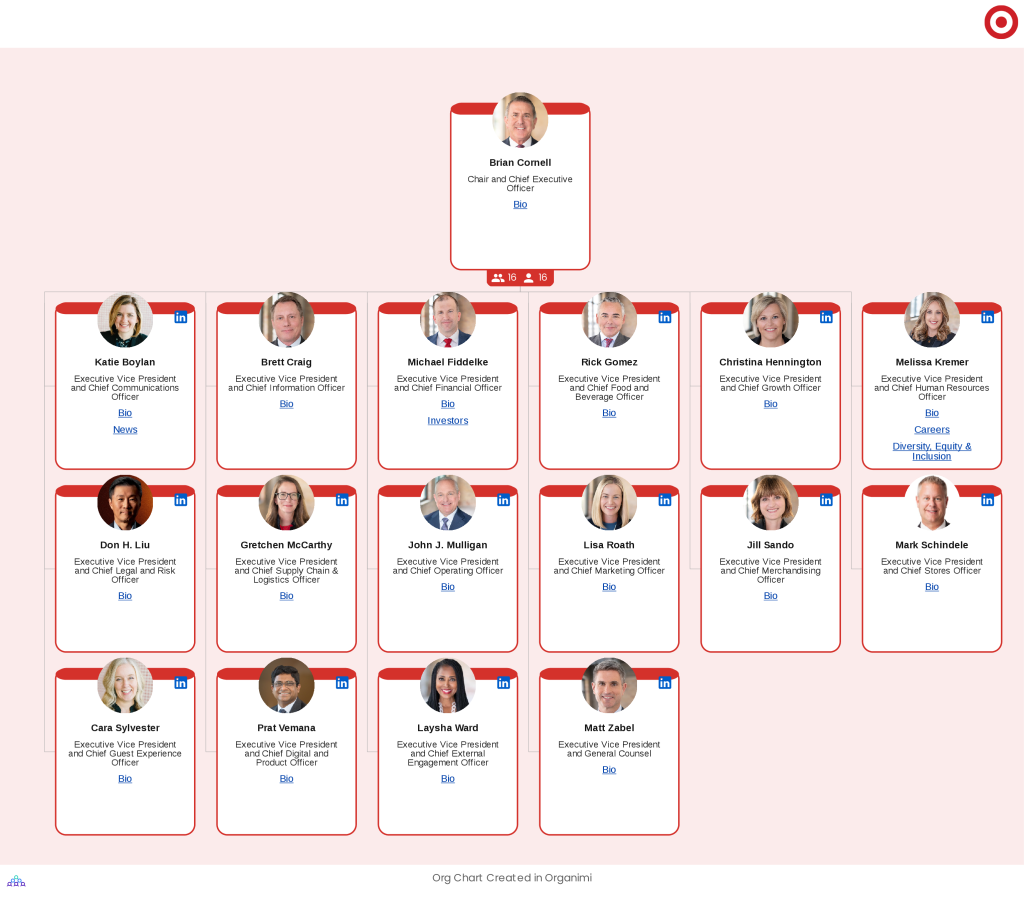
Target’s Board of Directors currently lists Michael Fiddelke and Brian Cornell as the only two non-independent directors.
Every other board member is independent under NYSE listing standards, a requirement that protects shareholder interests.
Insider ownership (executives and board members combined) represents a small fraction of total shares relative to institutional holdings. These stakes are disclosed in SEC proxy statements.
Bullseye, Target’s iconic bull terrier mascot, may be the brand’s most recognizable face, but it’s the institutional shareholders who carry the real ownership weight.
CEO & Leadership
Important Update
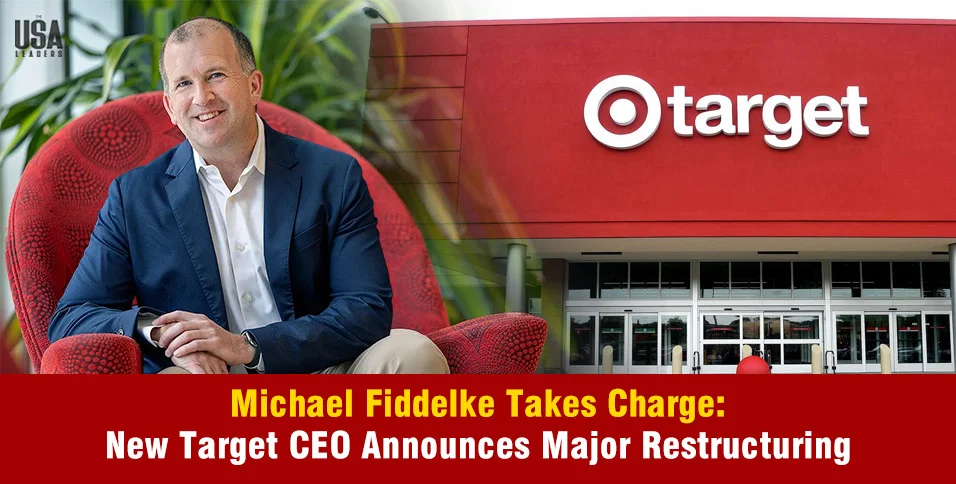
Michael Fiddelke is Target’s CEO as of February 2026. Any source still listing Brian Cornell as CEO is out of date.
This is the single biggest freshness gap in most articles covering Target Corporation ownership structure right now.
Fiddelke came up through Target’s finance organization, most recently serving as CFO before his promotion. His appointment signals operational continuity rather than a strategic overhaul.
Cornell didn’t leave entirely. He moved into the Executive Chairman role, staying connected to board-level decisions and shareholder accountability while Fiddelke handles day-to-day operations.
This kind of dual structure is common in large public companies navigating leadership transitions.
Cornell led Target from 2014 through early 2026, overseeing growth to $105 billion in annual net sales.
The CEO transition itself is a governance event, not just a personnel move.
Shareholders effectively sign off on who runs the company through the board they elect.
Corporate Structure
Shipt
Shipt is Target’s only major wholly-owned subsidiary. Target acquired it in 2017 for approximately $550 million.
Shipt operates as a same-day delivery marketplace, and its logistics infrastructure, customer data, and workforce all sit under Target’s corporate umbrella.
Important Note: Shipt employees are counted separately from Target’s core workforce.
Exclusive Brands
Target also owns 45+ exclusive brands, including:
- Good & Gather
- All in Motion
- A New Day
- Threshold
These are wholly controlled intellectual assets, not national brand partnerships.
They generate higher margins and give Target direct control over product development, pricing, and quality.
The corporate footprint extends well beyond store floors.
Target runs:
- 66 supply chain and fulfillment facilities
- 20+ global sourcing offices
Community Giving
Target’s 5% profit-giving commitment has been active since 1946, predating the company’s public listing.
That works out to roughly $4 million per week in community giving today.
Target Plaza in Minneapolis, Minnesota serves as the corporate headquarters, anchoring the company’s identity in the same city where George Dayton opened his first store over 120 years ago.
Target Canada
Target’s board approved the acquisition of Zellers store leases and a rapid push into Canada, opening 133 stores between 2011 and 2015.
Persistent supply chain failures and pricing misalignment drove every location to close by April 2015, resulting in a $5+ billion write-down.
It remains the most expensive strategic failure in the post-Dayton-Hudson era.
It also serves as a direct example of how board-level ownership decisions can produce costly international outcomes.
Employee Numbers
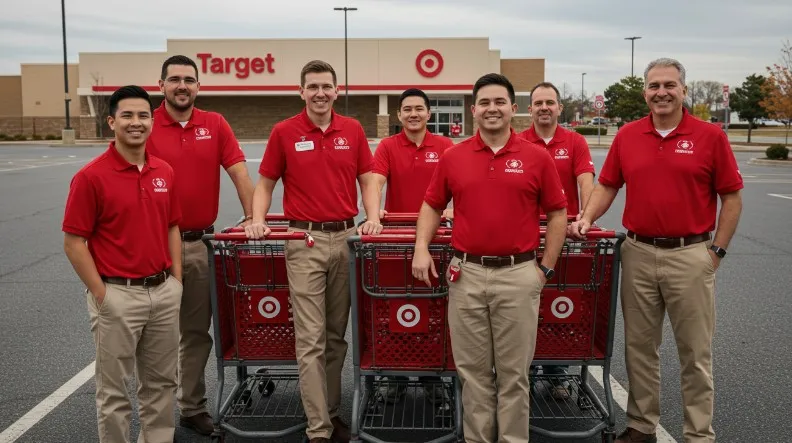
Target reports 400,000+ team members in 2026, including part-time and seasonal workers.
Workforce analytics firm Revelio Labs estimates active headcount at 177,409, down 8.5% year over year.
These figures aren’t contradictory; they use different methodologies. Target’s number includes all employment types, while Revelio likely measures active employees or full-time equivalents at a specific point in time.
The decline in active headcount alongside $105 billion in annual sales suggests Target is generating more revenue with fewer workers, likely driven by self-checkout, automation, and operational efficiencies., and supply chain efficiency investments.
Those 400,000+ employees aren’t just store associates.
They’re spread across:
- 2,000+ U.S. stores
- 66 distribution and fulfillment centers
- 20+ global sourcing offices
With 75%+ of the U.S. population living within 10 miles of a Target store, that geographic density requires a workforce distributed across nearly every corner of the country.
From Dayton’s to Target
The story starts in 1902.
George Dayton founded Goodfellow Dry Goods in Minneapolis, which later became Dayton’s department stores.
The Target brand launched in 1962 in Roseville, Minnesota, with retail executive John Geisse developing the discount store concept and Douglas Dayton helping bring it to market.
The company operated as Dayton-Hudson Corporation from 1969 to 2000.
By the late 1990s, Target stores generated about 75% of the company’s revenue, making the corporate name increasingly disconnected from its core business.
As a result, Dayton-Hudson rebranded as Target Corporation in 2000. The move aligned the company’s identity with its primary growth engine and did not change its ownership structure.
No Dayton family member held controlling ownership by that point. The company had long since transitioned from a family business to a publicly traded corporation.