What Is Target’s 10-4 Policy? (And What It Means for Shoppers)

The Target 10-4 policy is one of the most talked-about customer service standards in retail.
If you have ever worked at Target or shopped there regularly, you have likely experienced this policy in action, even if you did not know it by name.
It is a simple but effective guideline that shapes how Target team members interact with guests on the sales floor.

Quick Overview
- The Target 10-4 policy requires employees to acknowledge guests within 10 feet and verbally greet them within 4 feet.
- This rule is rooted in a broader retail strategy designed to boost customer satisfaction and reduce theft.
- Target team members receive training on this policy during onboarding, and it plays a role in performance evaluations.
What Is the Target 10-4 Policy?
The Target 10-4 policy is a customer engagement rule used across Target stores nationwide.
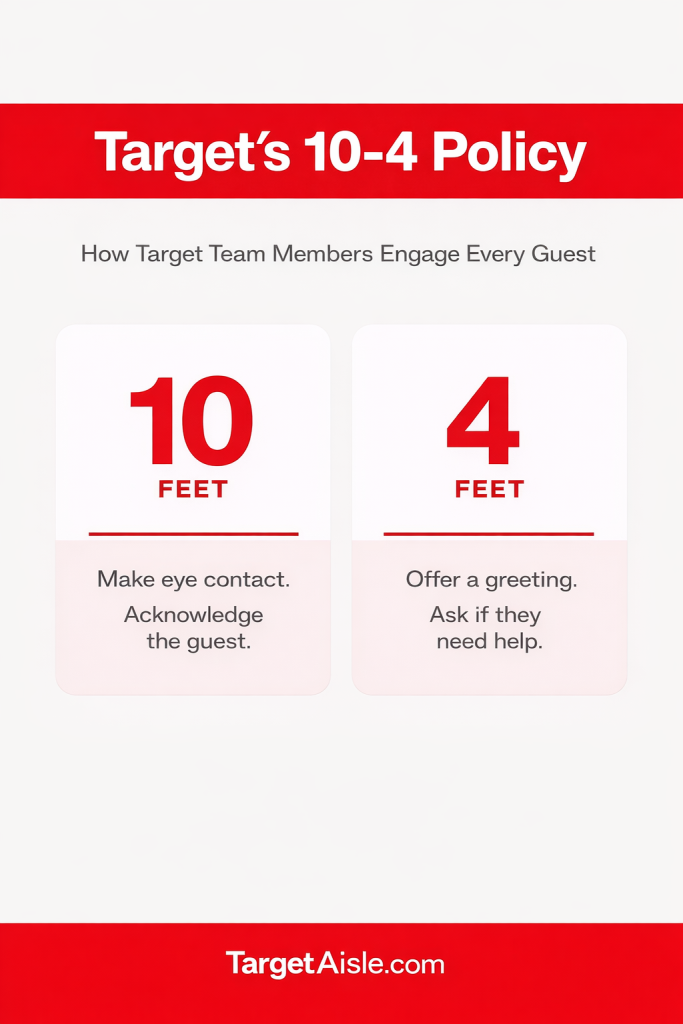
It sets two distance-based expectations for employees, also known as team members. When a guest is within 10 feet, the team member should make eye contact and acknowledge their presence.
When the guest comes within 4 feet, the team member should offer a verbal greeting or ask if they need help.
This concept is not unique to Target. It is sometimes called the “10 and 10 rule” or the “10-foot rule” in other retail settings. Walmart founder Sam Walton famously championed a version of this approach.
However, Target’s 10-4 version adds a more layered structure by distinguishing between a nonverbal acknowledgment and a spoken greeting.
Why Target Uses the 10-4 Rule
Retail success depends heavily on how customers feel when they walk through the doors. A friendly greeting can turn a routine errand into a pleasant experience.
Target has built its brand around being a more welcoming, aesthetically appealing alternative to big-box competitors. The 10-4 policy reinforces that image at the ground level.

According to Target’s corporate site, the company invests significantly in team member training to create a consistent guest experience across all locations. The 10-4 rule is a core piece of that training.
Loss Prevention
There is also a practical, less obvious reason behind the policy. Acknowledging people as they move through a store is one of the oldest and most effective loss prevention strategies.
When a potential shoplifter knows they have been seen and noticed, they are far less likely to follow through.
Employee Accountability
The policy also gives managers a clear, measurable standard to evaluate employee behavior on the floor.
Instead of vaguely asking team members to “be friendly,” the 10-4 rule sets concrete expectations.
It is easier to coach someone on specific actions like making eye contact at 10 feet than on abstract ideas like “providing great service.”
How the Target 10-4 Policy Works in Practice
Here is what the policy looks like during a typical shift:
At 10 feet: A team member spots a guest approaching their area. They look up, make eye contact, and offer a smile or a nod. This signals awareness without being intrusive.
At 4 feet: As the guest gets closer, the team member says something simple like,
“Hi, can I help you find anything?” or “Let me know if you need anything.”
The key is that neither step should feel forced or robotic. Target trains its employees to be warm and genuine. A rushed, scripted greeting can sometimes feel worse than no greeting at all.
The best team members adapt their tone and approach based on the situation, such as reading body language to know when a guest wants help versus when they prefer to browse alone.
What New Target Employees Should Know
If you are starting a new job at Target, the 10-4 policy will come up early in your training. It is typically covered during orientation alongside other guest service expectations.
Here are a few things to keep in mind as you settle into the role:
- The first few days may feel awkward.
- You do not need a script.
- Stay aware of your surroundings.
- It applies to every guest, every time.
Team leads and managers may observe your interactions during shifts and provide feedback.
How Shoppers Experience the 10-4 Policy
As a shopper, you have probably noticed that Target employees tend to greet you more consistently than staff at many other stores.
That is the 10-4 policy at work. For most guests, it creates a welcoming atmosphere. You feel acknowledged without feeling pressured.
Some shoppers find frequent greetings slightly overwhelming, especially in smaller store formats where you may pass multiple team members in a short walk.
But the intent behind the policy is not to hover. It is to make sure every guest knows that help is available if they need it.
If you are someone who prefers to shop without interaction, a polite “I’m good, thanks” is all it takes. Target team members are trained to respect that response and move on.
How the 10-4 Policy Compares to Other Retailers
Target is not the only retailer with a customer acknowledgment rule, but it is one of the most disciplined about enforcing it.
Walmart
Uses a version of the 10-foot rule inspired by Sam Walton. Employees are encouraged to greet anyone within 10 feet.
There is no separate 4-foot step.
Costco
Focuses more on membership desk interaction and checkout friendliness. Floor engagement is less structured.
Nordstrom
Known for exceptional customer service, but relies more on individual employee judgment than a specific distance-based rule.
Common Misconceptions About the Target 10-4 Policy
With every new policy launched into the business, there are always some misconceptions about it. Target also some.
“It’s Just About Being Nice”
While friendliness is a big part of it, the policy also serves loss prevention and operational goals. It is a multi-purpose tool, not just a courtesy guideline.
“You Can Get Fired for Not Following It”
Failing to follow the 10-4 rule alone is unlikely to result in termination.
However, consistently ignoring guest engagement expectations could factor into performance discussions and corrective action over time.
Like any workplace standard, it is one piece of a larger evaluation.
“It Only Applies to Sales Floor Team Members”
The 10-4 policy applies to all team members who interact with guests, not just those assigned to the sales floor.
This includes employees working in fulfillment who happen to be on the floor, team members restocking shelves, and even leadership walking through the store.
The Role of the 10-4 Policy in Target’s Brand Identity
Target has spent decades positioning itself as a step above the typical discount retailer. Clean store layouts, exclusive designer collaborations, and a curated product selection all play a role. But none of that matters if the in-store experience feels cold or neglectful.
The 10-4 policy is one of the simplest ways Target protects its brand at the store level. It ensures that every guest interaction, no matter how brief, reflects the company’s values.
Target’s focus on guest experience has been recognized by organizations like the J.D. Power customer satisfaction surveys, where the company regularly performs well among mass retailers.
Does the 10-4 Policy Actually Work?
From a business standpoint, the answer is yes.
Anecdotally, many Target shoppers cite the friendly atmosphere as a key reason they choose Target over competitors.
From a loss prevention perspective, the data support the approach as well.
When people feel seen, they behave differently. The 10-4 rule leverages that psychology in a natural, non-confrontational way.
Leaving with…
The Target 10-4 policy is a simple but impactful part of what makes Target feel different from other big retailers.
For employees, it provides a clear expectation that is easy to follow and builds strong guest service habits.
For shoppers, it creates the kind of welcoming environment that keeps people coming back.